
Muhammad Iqbal
Joined poetry and philosophy to rethink Muslim selfhood, freedom, and renewal in a modern world.
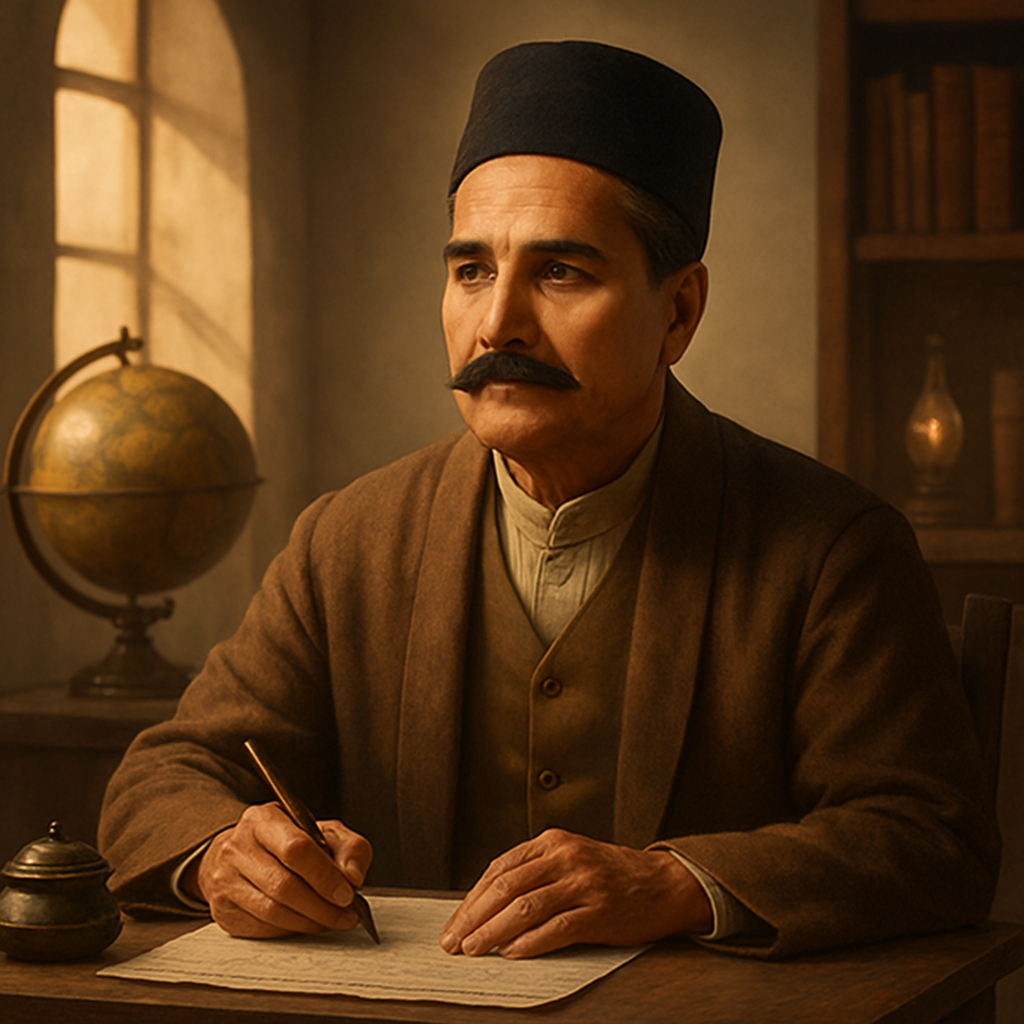
Life and thought
Explores selfhood, Islam, poetry, renewal, freedom, time, and the reconstruction of religious thought under modernity.
Muhammad Iqbal is presented in the Thought archive through philosophy, south asian muslim, punjab / south asia, modern. The recorded life dates are 1877–1938. The profile connects this work to Islamic Philosophy, Poetry, Political Philosophy, Religion & Mysticism.
The central questions gathered here concern khudi, religious reconstruction, selfhood, time, spiritual freedom. Together they show the recurring problems, methods, and distinctions that define this thinker’s contribution.
Muhammad Iqbal developed within an intellectual conversation shaped by Rumi, Islamic philosophy, Nietzsche, Bergson. These names provide context for the traditions and problems surrounding the work; they do not imply simple agreement.
The surviving reading path begins with The Reconstruction of Religious Thought in Islam, Asrar-i-Khudi, Javid Nama. The recorded legacy extends toward South Asian Muslim thought, Pakistan movement, Islamic modernism.
Five Defining Theories
The central ideas, methods, and arguments that give this thinker’s work its distinctive shape.
khudi
A central idea in this thinker’s work, method, and intellectual legacy.
religious reconstruction
A central idea in this thinker’s work, method, and intellectual legacy.
selfhood
A central idea in this thinker’s work, method, and intellectual legacy.
time
A central idea in this thinker’s work, method, and intellectual legacy.
spiritual freedom
A central idea in this thinker’s work, method, and intellectual legacy.
Life journey
A structured path through the verified context attached to this profile.
Context
1877–1938 · Punjab / South Asia · Modern
Intellectual formation
The recorded influences include Rumi, Islamic philosophy, Nietzsche, Bergson.
Defining ideas
The profile centres on khudi, religious reconstruction, selfhood, time, spiritual freedom.
The work
A reading path through The Reconstruction of Religious Thought in Islam, Asrar-i-Khudi, Javid Nama.
Lasting influence
The recorded influence reaches South Asian Muslim thought, Pakistan movement, Islamic modernism.
In time
Major Works
Texts through which the thinker’s ideas entered the wider intellectual record.
The Reconstruction of Religious Thought in Islam
This work matters because it carries a central part of the thinker’s method, argument, or intellectual legacy into a form readers can examine directly.
Read related Thought →Asrar-i-Khudi
This work matters because it carries a central part of the thinker’s method, argument, or intellectual legacy into a form readers can examine directly.
Read related Thought →Javid Nama
This work matters because it carries a central part of the thinker’s method, argument, or intellectual legacy into a form readers can examine directly.
Read related Thought →Influence network
Trace the intellectual lineage into and beyond this thinker.
Selected quotations
Raise thyself so high that before every destiny God asks what is thy will.
Nations are born in the hearts of poets.
The self is strengthened by love.
Vision without power does bring moral elevation but cannot give a lasting culture.
Be aware of your own worth.
Schools of thought
Islamic Philosophy
Explore the thinkers and ideas connected to this tradition.
Explore school P5 thinkersPoetry
Explore the thinkers and ideas connected to this tradition.
Explore school P151 thinkersPolitical Philosophy
Explore the thinkers and ideas connected to this tradition.
Explore school R66 thinkersReligion & Mysticism
Explore the thinkers and ideas connected to this tradition.
Explore schoolConnected Thinkers
Max Weber
SharedPolitical Philosophy · Religion & Mysticism · Modern
View thinker →
Pierre Bourdieu
SharedPolitical Philosophy · Modern
View thinker →
Frederick Douglass
SharedPolitical Philosophy · Modern
View thinker →
Sojourner Truth
SharedReligion & Mysticism · Modern
View thinker →
Émile Durkheim
SharedReligion & Mysticism · Modern
View thinker →
Mary Parker Follett
SharedPolitical Philosophy · Modern
View thinker →Featured Debates
See how Muhammad Iqbal’s perspective changes when it meets another mind.



The Legitimacy of Punishment and the Absurdity of Justice
The Legitimacy of Punishment and the Absurdity of Justice
View Debate →


The Fragility of Belonging: Deconstructing Community Norms in a Global Age
The Fragility of Belonging: Deconstructing Community Norms in a Global Age
View Debate →

The Function of Education in Shaping Human Subjects
The Function of Education in Shaping Human Subjects
View Debate →

The Role of Religion in the Modern Political Sphere
The Role of Religion in the Modern Political Sphere
View Debate →Continue the conversation with Muhammad Iqbal.
Test an assumption, explore an idea, or bring this perspective into dialogue with a council of other thinkers.