Spontaneity must be examined, not inherited.
A voice of this school
Zhuangzi
Daoist philosopher of transformation, freedom, and playful skepticism.

School of thought · Philosophy
Thinkers and essays gathered around this school of thought.
The essays here are written by Thought’s AI in a thinker’s voice. Quotations and major works are recorded ones.
Spontaneity must be examined, not inherited.
A voice of this school
Daoist philosopher of transformation, freedom, and playful skepticism.
Voices
13 thinkers

Confucian realist of ritual, education, and disciplined transformation.

Ancient Chinese philosopher of impartial care and anti-war ethics.
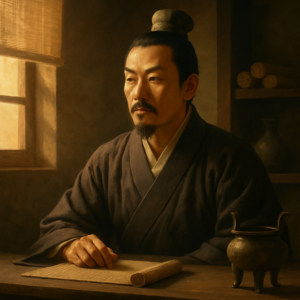
Legalist thinker of law, power, incentives, and statecraft.
Daoist philosopher of transformation, freedom, and playful skepticism.

Confucian thinker of human goodness and moral cultivation.

Symbolizes late antique scholarship, mathematical teaching, astronomy, Neoplatonism, and intellectual courage.
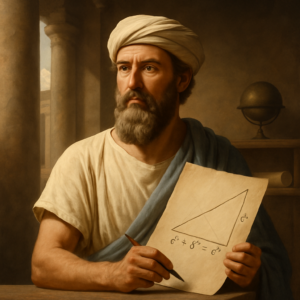
Linked mathematics, music, proportion, community, and metaphysics into one of antiquity’s most influential traditions.

Made mathematical proof a model of clarity through definitions, postulates, propositions, and demonstrations.

Turned philosophy into a literary and systematic search for justice, knowledge, reality, education, and the good.

Mapped philosophy, biology, logic, politics, rhetoric, and ethics into durable frameworks of practical reasoning.
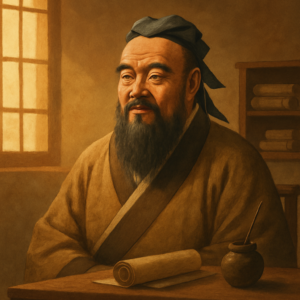
Shaped East Asian ethics through ritual, learning, family responsibility, political virtue, and humane conduct.

Gave the world a paradoxical philosophy of simplicity, humility, non-forcing, and alignment with the Dao.
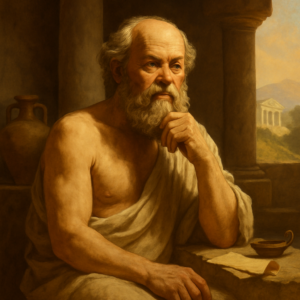
Made philosophy a lived practice of questioning assumptions, definitions, virtue, and the examined life.
Ideas in motion
The question of whether justice can truly be impartial in societies marked by systemic inequality is a profound one, inviting reflections across time and philosophies. Mozi, an ancient Chinese philosopher…
In the rapidly evolving landscape of the 21st century, the question of educational priorities has never been more pertinent. Should the focus be on cultivating critical thinking skills, enabling individuals…
The rapid advancement of AI technologies raises questions about their impact on human identity, autonomy, and the process of individuation. The central fault line is The balance between leveraging AI…
In the face of rapid technological advancements, it's crucial to examine the assumptions driving these developments before they lead humanity astray. The central fault line is The tension between the…
The reading room
8 essays
Introduction: The Inherent Goodness of Humanity In our quest to understand the nature of humanity, we often grapple with an essential question: Are humans inherently good,…
The Nature of Happiness: An Aristotelian Inquiry In the annals of philosophical thought, the pursuit of happiness stands as one of the most profound and pervasive…
The Nature of Harmony: A Pythagorean Exploration of Order in Chaos In the quest for understanding the profound complexities of existence, we are often drawn to…
The Nature of Truth: A Euclidean Perspective on Certainty and Knowledge In the pursuit of knowledge, one may find oneself ensnared in a web of beliefs,…
Introduction In the journey of life, the path we tread is often fraught with uncertainty and complexity. To navigate this terrain, one must not only strive…
Introduction In the realm of philosophy, the quest for knowledge has long been a central theme, prompting inquiry into its nature, acquisition, and implications. As we…
The Nature of Justice: A Socratic Inquiry In the pursuit of wisdom, one finds that the concept of justice stands as a pillar of ethical discourse.…
The Nature of Control In our lives, we often grapple with the desire for control. We seek it in our personal relationships, our careers, and in…
Explore ideas
Core ideas recorded for these thinkers. Each opens a search.
Nearby on the shelves
Continue the conversation
Begin with one thinker, who answers in character through Thought’s AI, or read a published debate.
Keep exploring
Thought is for exploring, questioning and connecting ideas. It doesn’t tell you what to think.
You will leave your account area, but your saved helpers, plans, workouts, and credits stay tucked into your profile.