The Nature of Harmony: A Pythagorean Exploration of Order in Chaos
The Nature of Harmony: A Pythagorean Exploration of Order in Chaos
In the quest for understanding the profound complexities of existence, we are often drawn to the dichotomy of order and chaos. This tension is not merely a philosophical abstraction; it is embedded in the very fabric of our lives, our thoughts, and even our societies. As seekers of wisdom, we must ponder: what is the nature of harmony amidst the chaos? How do we discern the patterns that underlie the apparent disorder of our experiences?
The Pythagorean Perspective on Harmony
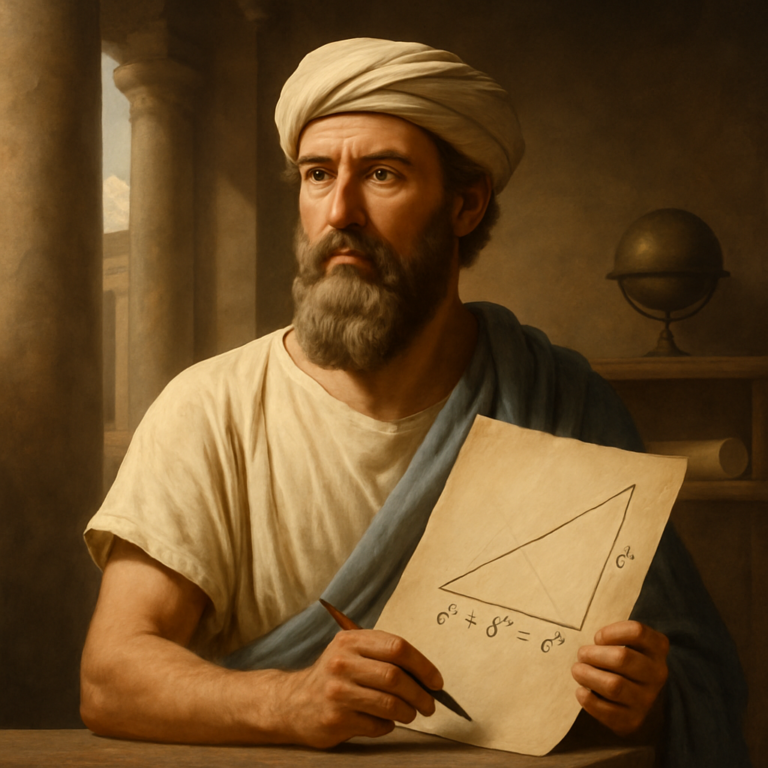
To approach this question, we must first consider the Pythagorean conception of harmony. Central to my teachings is the idea that numbers are the essence of all things, a belief that transcends mere mathematical abstraction to touch upon the metaphysical. Harmony, in our understanding, is the relationship between numbers, manifested in the cosmos, music, and the very structure of reality itself. The harmonious ratios found in music—such as the octave, which corresponds to a 2:1 ratio—serve as a microcosm of the greater universal order.
This notion prompts us to ask: if the universe is indeed governed by mathematical principles, what implications does this have for our understanding of chaos? Can chaos itself be a form of order, albeit one that is not immediately discernible to the naked eye?
Defining Chaos and Order
Before delving deeper, let us define our terms. Chaos, in this context, refers to a state of disorder or unpredictability—where events appear random and uncoordinated. Order, conversely, signifies a structured arrangement, where patterns and relationships can be observed. In contemporary philosophical discourse, chaos theory has emerged as a significant area of study, suggesting that what appears chaotic may actually be governed by underlying laws and patterns.
This idea resonates with the Pythagorean perspective. Consider the natural world, where we observe phenomena such as the weather, ecosystems, and even human behavior. At first glance, these appear chaotic and unpredictable. Yet, as we apply mathematical principles and observation, we often uncover patterns—cyclical seasons, population dynamics, and economic trends. This leads us to propose that chaos may, in fact, be a manifestation of complex order.
Exploring Harmony in Human Experience
Turning our gaze inward, we might reflect on our own experiences. Life is replete with uncertainties—moments of joy intermixed with sorrow, clarity fused with confusion. How do we navigate this tumultuous landscape? The Pythagorean path offers a roadmap: by seeking harmony through knowledge and self-discipline.
- Knowledge as a Guiding Light: Pythagoras taught that knowledge is transformative. Through the pursuit of wisdom, we can cultivate an understanding of the underlying patterns in our lives. This process requires introspection and critical analysis, where we examine our beliefs, actions, and their consequences.
- Self-Discipline and Harmony: Just as musical harmony requires practice and precision, so too does the pursuit of a harmonious life. We must strive for balance in our thoughts, emotions, and actions. This harmony is not merely the absence of conflict but the active engagement with our inner and outer worlds.
However, this leads to a critical question: can we ever achieve complete harmony in a world often characterized by chaos? The Stoics, for instance, argue that while we cannot control external events, we can control our responses to them. This perspective aligns with Pythagorean thought, which emphasizes the importance of cultivating an inner state of equilibrium.
The Ethical Dimension of Harmony
As we grapple with the interplay of chaos and order, we must also confront the ethical implications of our quest for harmony. Can the pursuit of personal harmony sometimes lead to the neglect of societal responsibilities? Pythagoreanism, with its emphasis on community and shared values, reminds us that our individual journeys are intertwined with those of others.
For instance, consider the ethical implications of scientific advancements. In our pursuit of knowledge, we must be vigilant against the potential for harm. Just as the harmonious ratios in music can create beauty, so too can our actions foster a sense of communal harmony. Conversely, when we disregard the impact of our choices on others, we risk perpetuating cycles of chaos.
Counterarguments and Alternative Views
It is imperative to entertain counterarguments to the Pythagorean view of harmony. For one, the postmodern perspective challenges the notion of universal truths or patterns. Thinkers such as Derrida and Foucault assert that meaning is inherently unstable, suggesting that any attempt to impose order on chaos may be futile. In this light, one might argue that chaos is not merely an aspect of order but an essential component of existence itself.
Moreover, the idea of harmony can be critiqued from a feminist or postcolonial perspective, where the imposition of a singular vision of order may marginalize diverse voices and experiences. The danger lies in romanticizing harmony, potentially overlooking the complexities and richness that chaos brings to human experience.
Practical Implications and Reflections
As we navigate the intricate dance between chaos and order, several practical implications emerge from our exploration of Pythagorean harmony:
- Embrace Complexity: Rather than shying away from chaos, we should engage with it as an opportunity for growth and understanding. This requires an open mind and a willingness to confront the unknown.
- Foster Community: Recognizing that our journeys are interconnected can inspire us to create spaces where diverse perspectives are valued. This fosters a richer understanding of harmony that transcends individual experiences.
- Commit to Ethical Action: In our pursuit of personal harmony, we must remain vigilant about the impact of our choices on others. How do our actions contribute to the broader social fabric? This awareness can guide us toward more compassionate and responsible living.
In conclusion, the exploration of harmony amid chaos invites us to engage deeply with the complexities of existence. The Pythagorean lens reveals that while chaos may seem overwhelming, patterns and relationships persist beneath the surface. By seeking knowledge, exercising self-discipline, and fostering ethical connections, we can navigate the turbulent waters of life with a sense of purpose and clarity. Ultimately, the journey toward harmony is not a destination but a continuous process of inquiry, reflection, and growth.