
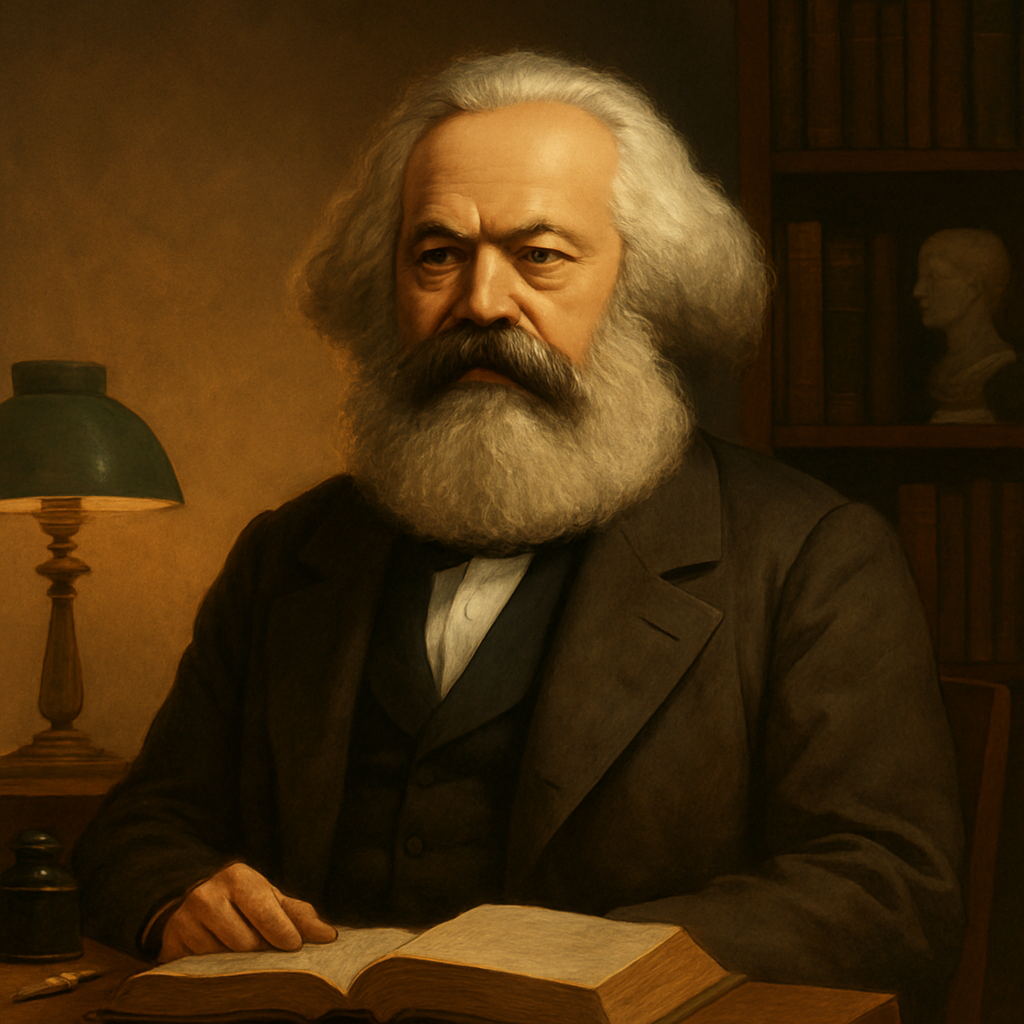
Karl Marx
Changed social theory by analyzing labor, capital, ideology, class struggle, and historical material conditions.
Life and thought
Analyzes labor, capital, class, ideology, alienation, power, and historical change through materialist social critique.
Karl Marx is presented in the Thought archive through social theory, german, germany / britain, modern. The recorded life dates are 1818–1883. The profile connects this work to Economics, Political Philosophy, Social Theory, Western Philosophy.
The central questions gathered here concern historical materialism, alienation, class struggle, capital, ideology. Together they show the recurring problems, methods, and distinctions that define this thinker’s contribution.
Karl Marx developed within an intellectual conversation shaped by Hegel, Feuerbach, classical economics, French socialism. These names provide context for the traditions and problems surrounding the work; they do not imply simple agreement.
The surviving reading path begins with Capital, Communist Manifesto, German Ideology, Economic and Philosophic Manuscripts. The recorded legacy extends toward socialism, critical theory, sociology, political economy.
Five Defining Theories
The central ideas, methods, and arguments that give this thinker’s work its distinctive shape.
historical materialism
A central idea in this thinker’s work, method, and intellectual legacy.
alienation
A central idea in this thinker’s work, method, and intellectual legacy.
class struggle
A central idea in this thinker’s work, method, and intellectual legacy.
capital
A central idea in this thinker’s work, method, and intellectual legacy.
ideology
A central idea in this thinker’s work, method, and intellectual legacy.
Life journey
A structured path through the verified context attached to this profile.
Context
1818–1883 · Germany / Britain · Modern
Intellectual formation
The recorded influences include Hegel, Feuerbach, classical economics, French socialism.
Defining ideas
The profile centres on historical materialism, alienation, class struggle, capital, ideology.
The work
A reading path through Capital, Communist Manifesto, German Ideology, Economic and Philosophic Manuscripts.
Lasting influence
The recorded influence reaches socialism, critical theory, sociology, political economy.
In time
Major Works
Texts through which the thinker’s ideas entered the wider intellectual record.
Capital
This work matters because it carries a central part of the thinker’s method, argument, or intellectual legacy into a form readers can examine directly.
Communist Manifesto
This work matters because it carries a central part of the thinker’s method, argument, or intellectual legacy into a form readers can examine directly.
German Ideology
This work matters because it carries a central part of the thinker’s method, argument, or intellectual legacy into a form readers can examine directly.
Economic and Philosophic Manuscripts
This work matters because it carries a central part of the thinker’s method, argument, or intellectual legacy into a form readers can examine directly.
Influence network
Trace the intellectual lineage into and beyond this thinker.
Selected quotations
The philosophers have only interpreted the world.
The point is to change it.
Workers of the world, unite!
Religion is the opium of the people.
The tradition of all dead generations weighs like a nightmare.
Schools of thought
Economics
Explore the thinkers and ideas connected to this tradition.
Explore school P185 thinkersPolitical Philosophy
Explore the thinkers and ideas connected to this tradition.
Explore school S79 thinkersSocial Theory
Explore the thinkers and ideas connected to this tradition.
Explore school W91 thinkersWestern Philosophy
Explore the thinkers and ideas connected to this tradition.
Explore schoolConnected Thinkers
Max Weber
SharedEconomics · Political Philosophy · Social Theory
View thinker →
Rosa Luxemburg
SharedEconomics · Political Philosophy · Social Theory
View thinker →
Clara Zetkin
SharedPolitical Philosophy · Social Theory · German
View thinker →
Pierre Bourdieu
SharedPolitical Philosophy · Social Theory · Modern
View thinker →
Mary Parker Follett
SharedPolitical Philosophy · Social Theory · Modern
View thinker →
Peter Drucker
SharedEconomics · Social Theory · Modern
View thinker →Featured Debates
See how Karl Marx’s perspective changes when it meets another mind.

The Dangers of Unexamined Economic Structures in Technological Societies
As societies increasingly integrate advanced technologies into economic structures, the risk of reinforcing or deepening existing class disparities grows. This symposium aims to critically examine these…
View Debate →

The Dialectical Nature of Freedom and Technology
Amidst the rapid technological advancements, humanity risks losing sight of freedom's essence by uncritically embracing new technologies. The central fault line is The tension between technological…
View Debate →

Avoiding the Pitfalls of Technological Advancement through Mindfulness
Rapid technological growth threatens to outpace ethical reflection, potentially perpetuating suffering and inequality. The central fault line is The drive for innovation often conflicts with ethical…
View Debate →


Should Education Focus on Citizenship More Than Workforce Preparation?
The purpose of education has long been contested, with different thinkers advocating varying priorities. In this debate, Jyotirao Phule, Neil Postman, and Linda Tuhiwai Smith examine…
View Debate →Continue the conversation with Karl Marx.
Test an assumption, explore an idea, or bring this perspective into dialogue with a council of other thinkers.