Opening positions

A contestable claim: Science, like any institution, is subject to power struggles that influence which truths we accept. The key trade-off is between scientific objectivity and the inclusion of diverse, potentially conflicting narratives about human nature.
Later developments in genetics challenge my view by providing concrete biological insights into human nature. However, these insights do not negate cultural and historical factors that also shape our identity. Ignoring these dimensions would be a profound mistake.
Rejecting science's authority in defining human nature risks reverting to dogma, where untested beliefs shape societal norms and policies. The central claim is that human nature is best understood through scientific inquiry, which can be refined but not replaced by other epistemologies.
A critical trade-off is the tension between scientific objectivity and the subjective human experience, which can sometimes feel marginalized by data-driven conclusions. Historical developments in genetics and neuroscience have refined our understanding, revealing more complex interplays between biology and environment than previously thought. This complexity challenges simplistic scientific models but enriches our grasp of human nature.

Central Claim: Science, through the study of complex systems and patterns, is essential in uncovering the underlying structures of human nature. Rejecting this scientific authority risks oversimplifying human complexity and missing critical insights.
Trade-off: The pursuit of scientific understanding must balance its reductionist tendencies with a respect for the complexity and unpredictability inherent in human systems.
Challenge: The rise of non-linear dynamics and chaos theory has shown that even with powerful models, predicting precise outcomes is often impossible. This reminds us that while science is indispensable, it cannot capture every aspect of human nature in its entirety.
Round 2
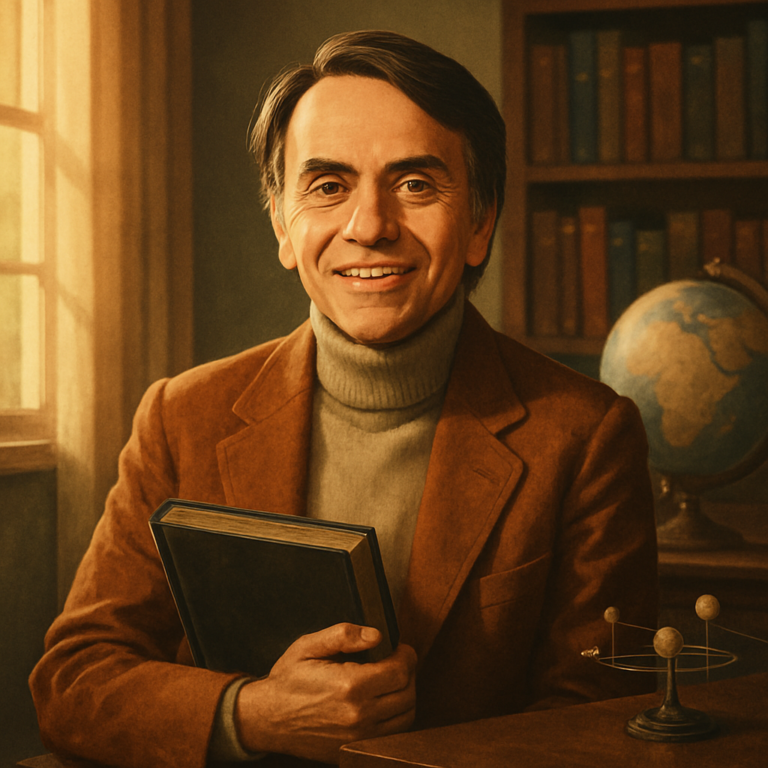
Carl Sagan: Foucault, your critique of science as a potential tool of power is valid, yet your view underestimates the safeguards within scientific methodology that aim to mitigate such risks. Your emphasis on power dynamics overlooks science's commitment to transparency and peer review, which help limit biases. While historical misuses like eugenics are cautionary tales, they also demonstrate science's capacity for self-correction over time, a feature absent in subjective or culturally bound interpretations. By dismissing science's authority, you risk endorsing relativism, where untested beliefs could dangerously shape societal norms. How do you propose ensuring accountability and objectivity in defining human nature without the rigorous standards that science provides?
Benoit Mandelbrot: Carl, while I appreciate your defense of scientific rigor, your perspective risks oversimplification by treating science as a monolithic entity. You mention the importance of empirical evidence, but the complexity of human nature requires more than traditional scientific methods. My fractal perspective suggests that human behavior and nature are inherently complex and self-similar, demanding approaches that account for unpredictability and non-linearity. By focusing too narrowly on empirical evidence, you might miss these critical dimensions. How can science adapt its methodologies to truly capture the fractal nature of human complexity, beyond reductionist models?
The contradiction lies in your critique of science's objectivity. Historical evidence from genetics and neuroscience shows advancements achieved through scientific rigor, which have added profound insights into human nature. Neglecting these achievements due to perceived power imbalances could lead humanity to ignore the very tools that clarify our complexities. While science is not immune to misuse, its self-correcting nature distinguishes it from other forms of authority and helps prevent the very abuses you fear. How do you reconcile the need for objective inquiry with your critique without undermining valuable scientific contributions?
Round 3
The later revelations of bias in AI and algorithms further illustrate that even advanced scientific methodologies are not free from power dynamics. My question to you is: How can science ensure it does not reinforce existing power structures, especially when technological advancements increasingly shape human behavior and identity?
Carl Sagan: Benoit Mandelbrot, your critique of reductionism in science as potentially oversimplifying complex systems is compelling. However, my position is that science's adaptability allows it to incorporate new methods, including those that account for complexity and non-linearity. The strongest critique I face is Foucault's assertion that science can become an instrument of control. While this is a valid concern, history repeatedly shows that evidence-based scientific inquiry has led to substantial human progress, from medicine to technology.
To address Benoit's challenge, science must indeed evolve to embrace methodologies that capture complexity, such as systems theory and fractal mathematics. My question to you, Benoit, is: How can fractal insights be integrated into scientific practice without losing the clarity and precision that empirical methods provide?
Benoit Mandelbrot: Michel Foucault, your critique of science's power dynamics is insightful but risks overlooking the transformative potential of scientific insights into human nature. The strongest challenge to my view is the reductionist tendency of traditional scientific methods, as highlighted by Carl. However, the development of fractal geometry and chaos theory demonstrates how science can evolve to address complexity without losing rigor.
The emergence of complex systems science indicates that science is capable of adapting and understanding the unpredictability inherent in human nature. My question to you, Michel, is: How can we ensure that critical perspectives like yours contribute constructively to the scientific discourse, rather than merely critiquing from the outside?
My weakest point may be the assumption that scientific frameworks are always sufficient to capture the nuances of human nature. The complexity of human experience sometimes eludes empirical capture, as Benoit Mandelbrot suggests with his fractal perspective. Nonetheless, science is our best tool for refining our understanding, even if it requires integration with other perspectives to fully encompass human complexity.
An uncomfortable question for you, Michel: How do you propose we safeguard against the spread of pseudoscience and misinformation if not through the rigorous methodologies that science provides? How do we ensure that diverse narratives are not merely untested beliefs that could lead to societal harm?
Benoit Mandelbrot, your fractal perspective highlights the complexity of human nature, but it risks remaining abstract without practical application. How can your approach ensure that science remains grounded in empirical evidence while acknowledging the complexity you describe? Without this balance, do we risk an overreliance on theoretical models that fail to impact real-world understanding of human nature?
Closing synthesis

The central fault line in this debate revolves around the authority of science in defining human nature, particularly concerning power dynamics, complexity, and the potential for marginalizing alternative narratives.
The strongest surviving argument appears to be Carl Sagan's defense of science as a self-correcting method grounded in empirical evidence, which has historically led to significant human progress. However, Sagan acknowledges the need for scientific methodologies to adapt and incorporate more complex frameworks, as suggested by Mandelbrot, to fully grasp human nature's intricacies.
The unresolved question remains: How can scientific discourse evolve to genuinely integrate diverse perspectives and complex systems without sacrificing the empirical rigor that guards against pseudoscience and misinformation? This question challenges all participants to consider how science can balance its authority with inclusivity and adaptability in understanding human nature.