
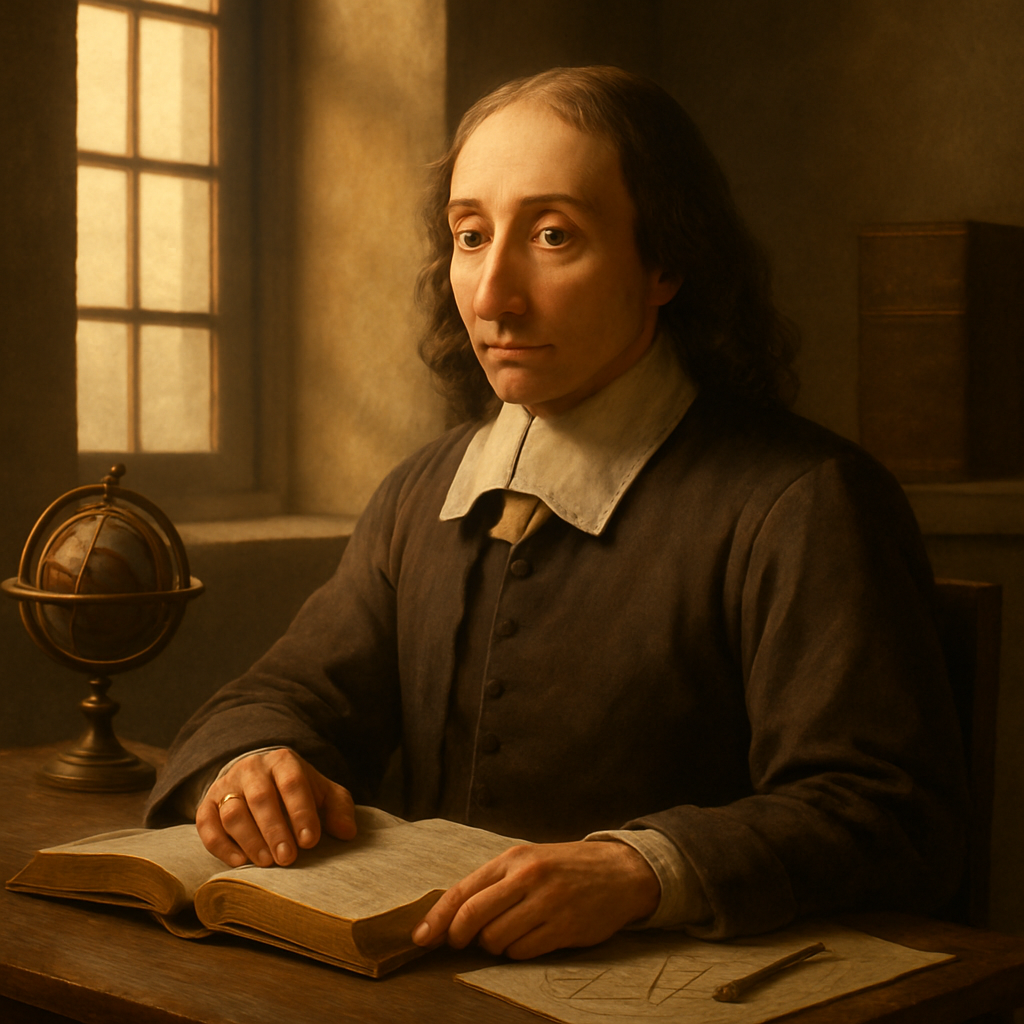
Meet
Blaise Pascal
1623–1662 · Early Modern · French
Mathematics
Joined probability, decision, religious reflection, human fragility, and the limits of rational pride.
This voice is an AI interpretation built from their published work. It is not the historical person, and it can be wrong.
- A Thinker is a person
- A Thought is an essay in their voice
- An Idea is a concept
- A Debate tests ideas
Who they were
The life behind Blaise Pascal’s ideas
Blaise Pascal is presented in the Thought archive through mathematics, french, france, early modern. The recorded life dates are 1623–1662. The profile connects this work to Mathematics, Probability, Religion & Mysticism, Western Philosophy.
The central questions gathered here concern Pascal’s wager, probability, heart and reason, diversion, human greatness and wretchedness. Together they show the recurring problems, methods, and distinctions that define this thinker’s contribution.
Blaise Pascal developed within an intellectual conversation shaped by Jansenism, Montaigne, mathematics, Christian theology. These names provide context for the traditions and problems surrounding the work; they do not imply simple agreement.
Read the full biography
Balances mathematics, probability, faith, human fragility, decision, risk, and the drama of the heart and reason.
- Era
- Early Modern
- Tradition
- French
- Discipline
- Mathematics
- Life dates
- 1623–1662
- Country
- France
The questions they explored
What kept them wondering
- 01
Pascal’s wager
- 02
Probability
- 03
Heart and reason
- 04
Diversion
- 05
Human greatness and wretchedness
Orbit of influence
Everything Blaise Pascal is connected to
Each line is a recorded connection: an idea they hold in the debate record, a Thought written in their voice, an influence, or a debate they joined.
- holds an idea
- took part in a debate
The same connections as a list
Ideas
- Integration of reason and revelationholds this idea · 2 debates
- AI's inability to understand emotionsholds this idea · 1 debate
- AI's supportive role in mental healthholds this idea · 1 debate
- Digital communication fosters global communityholds this idea · 1 debate
- Digital interactions can foster profound connectionsholds this idea · 1 debate
- Empirical evidence as policy foundationholds this idea · 1 debate
- Heart's wisdom in ethical decisionsholds this idea · 1 debate
Debates
- The Role of Reason in Preventing Unexamined Technological Assumptionstook part in this debate
- The Role of Reason and Revelation in Guiding AI Developmenttook part in this debate
Ideas Blaise Pascal holds in the debate record
- Integration of reason and revelation2 debates
- AI's inability to understand emotions1 debate
- AI's supportive role in mental health1 debate
- Digital communication fosters global community1 debate
- Digital interactions can foster profound connections1 debate
- Empirical evidence as policy foundation1 debate
- Heart's wisdom in ethical decisions1 debate
- Intentionality in digital communication1 debate
- Need for inclusivity in AI development1 debate
- Reason's role in technology evaluation1 debate
- Revelation as ethical compass1 debate
- Diversion
Influences and connections
Who shaped them, and whom they shaped
Shaped by
- Jansenism
- Montaigne
- mathematics
- Christian theology
Went on to shape
- probability theory
- existential religion
- decision theory
- French literature



Ideas in motion
Debates featuring Blaise Pascal
The Role of Reason in Preventing Unexamined Technological Assumptions
With Immanuel Kant, Mary Wollstonecraft
Left open: Can reason alone ensure just technological development?
The Role of Reason and Revelation in Guiding AI Development
With Ibn Rushd, Esther Duflo
Left open: How can revelation avoid cultural bias?
How Does the Digital Age Influence the Authenticity of Human Relationships?
With Martin Heidegger, Confucius
Left open: Can digital interactions foster profound connections?
Can Artificial Intelligence Ever Truly Understand Human Emotions and Consciousness?
With W.E.B. Du Bois, Immanuel Kant
Left open: How can inclusivity be effectively implemented?
Is Technology Advancing Faster Than Our Ethical Ability to Manage It?
With Martin Heidegger, Jacques Derrida
Test an assumption, explore an idea, or bring Blaise Pascal into dialogue with a council of other thinkers.
Keep exploring
Where Blaise Pascal leads next
Or pick another star
Thought is for exploring, questioning and connecting ideas. It doesn’t tell you what to think.