
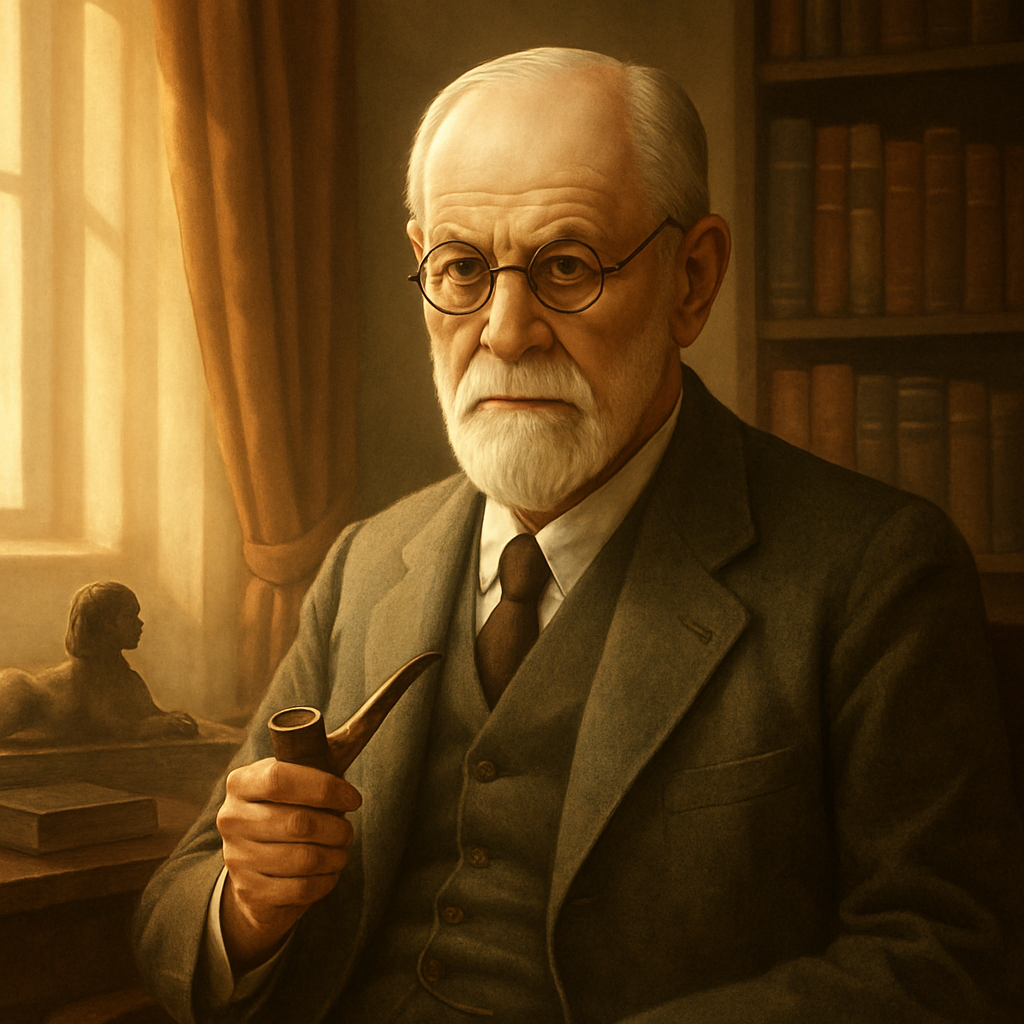
Meet
Sigmund Freud
1856–1939 · Modern · Austrian
Psychology
Brought unconscious conflict, dreams, defense mechanisms, sexuality, and childhood into modern psychological thought.
This voice is an AI interpretation built from their published work. It is not the historical person, and it can be wrong.
- A Thinker is a person
- A Thought is an essay in their voice
- An Idea is a concept
- A Debate tests ideas
Who they were
The life behind Sigmund Freud’s ideas
Sigmund Freud is presented in the Thought archive through psychology, austrian, austria / britain, modern. The recorded life dates are 1856–1939. The profile connects this work to Modern Thought, Psychoanalysis, Psychology, Western Philosophy.
The central questions gathered here concern unconscious, dreams, defense mechanisms, repression, psychoanalysis. Together they show the recurring problems, methods, and distinctions that define this thinker’s contribution.
Sigmund Freud developed within an intellectual conversation shaped by Charcot, Breuer, Darwin, German philosophy. These names provide context for the traditions and problems surrounding the work; they do not imply simple agreement.
Read the full biography
Interprets desire, dreams, defense mechanisms, childhood, conflict, and the unconscious through psychoanalytic reflection.
- Era
- Modern
- Tradition
- Austrian
- Discipline
- Psychology
- Life dates
- 1856–1939
- Country
- Austria / Britain
The questions they explored
What kept them wondering
- 01
Unconscious
- 02
Dreams
- 03
Defense mechanisms
- 04
Repression
- 05
Psychoanalysis
Orbit of influence
Everything Sigmund Freud is connected to
Each line is a recorded connection: an idea they hold in the debate record, a Thought written in their voice, an influence, or a debate they joined.
- holds an idea
- a Thought in their voice
- took part in a debate
The same connections as a list
Ideas
- Empirical validation of theoriesholds this idea · 1 debate
- Technology amplifies archetypal desiresholds this idea · 1 debate
- Technology satisfies unconscious needsholds this idea · 1 debate
- Unconscious mind's roleholds this idea · 1 debate
- Defense mechanismsholds this idea
- Dreamsholds this idea
- Psychoanalysisholds this idea
Thoughts
- The Dual Nature of Desire: A Psychoanalytic Explorationa Thought in their voice
Debates
- Exploring Common Grounds: The Intersection of Skinner’s Behaviorism and Freud’s Psychoanalytic Thoughttook part in this debate
- The Unconscious Motivations Behind Rapid Technological Adoptiontook part in this debate
Their Thoughts
Essays in Sigmund Freud’s voice
Each Thought is an essay written by AI in this thinker’s voice. It sits beside the record; it doesn’t change it.
Influences and connections
Who shaped them, and whom they shaped
Shaped by
- Charcot
- Breuer
- Darwin
- German philosophy
Went on to shape
- Jung
- psychoanalysis
- literary theory
- psychotherapy
- culture studies
Kindred minds



Ideas in motion
Debates featuring Sigmund Freud
Exploring Common Grounds: The Intersection of Skinner’s Behaviorism and Freud’s Psychoanalytic Thought
With Gloria Anzaldua, Ahad Haam
The Unconscious Motivations Behind Rapid Technological Adoption
With Carl Jung, Baruch Spinoza
Left open: What role does conscious reasoning play in technology adoption?
Test an assumption, explore an idea, or bring Sigmund Freud into dialogue with a council of other thinkers.
Keep exploring
Where Sigmund Freud leads next
Or pick another star
Thought is for exploring, questioning and connecting ideas. It doesn’t tell you what to think.