
Kwame Nkrumah
Made African unity, independence, and neocolonial critique central to global political thought.
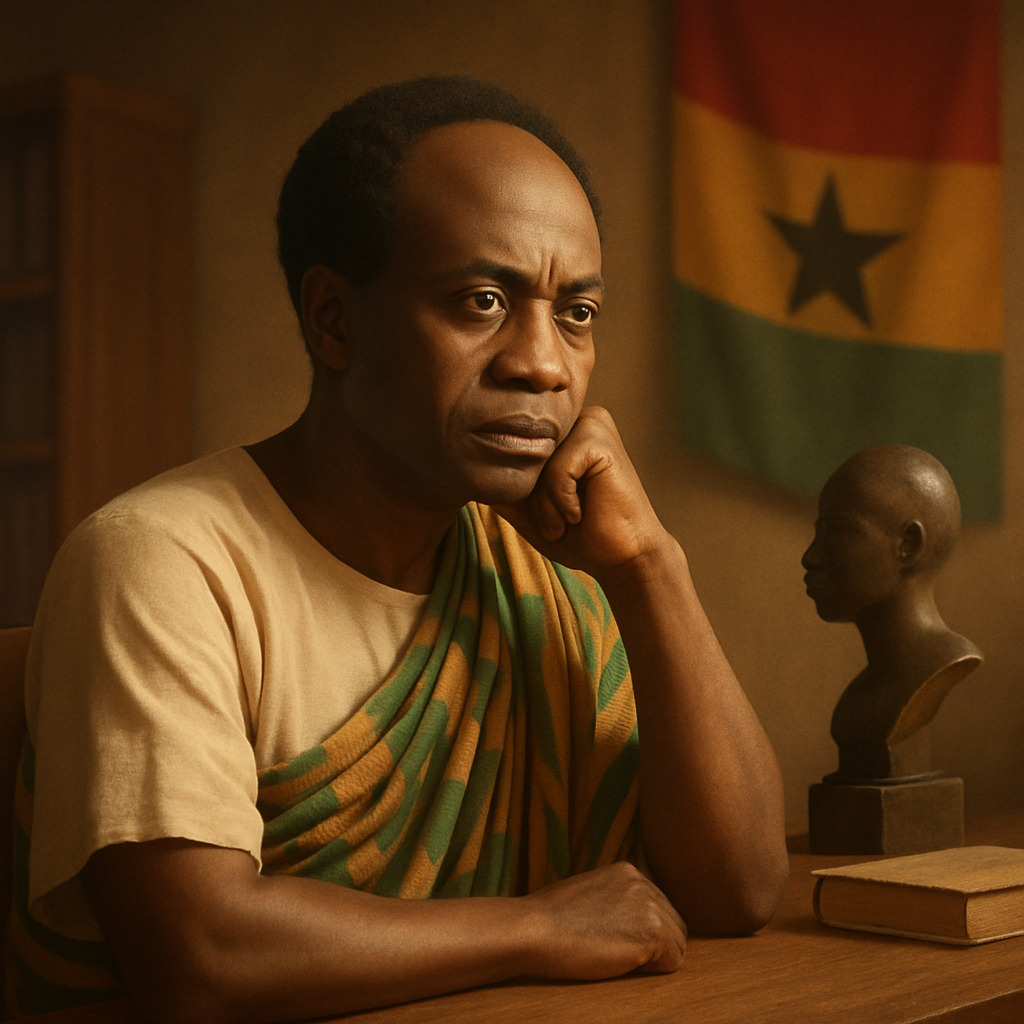
Life and thought
Analyzes Pan-Africanism, neocolonialism, socialism, independence, unity, and the dangers of fragmented liberation.
Kwame Nkrumah is presented in the Thought archive through political thought, ghanaian / pan-african, ghana, contemporary. The recorded life dates are 1909–1972. The profile connects this work to African Thought, Anti-Colonial Thought, Pan-Africanism, Political Philosophy.
The central questions gathered here concern Pan-Africanism, neocolonialism, African unity, socialism, liberation. Together they show the recurring problems, methods, and distinctions that define this thinker’s contribution.
Kwame Nkrumah developed within an intellectual conversation shaped by Marcus Garvey, W.E.B. Du Bois, Marxism, anti-colonial movements. These names provide context for the traditions and problems surrounding the work; they do not imply simple agreement.
The surviving reading path begins with Africa Must Unite, Neo-Colonialism, Consciencism. The recorded legacy extends toward African Union ideas, Pan-Africanism, liberation movements.
Five Defining Theories
The central ideas, methods, and arguments that give this thinker’s work its distinctive shape.
Pan-Africanism
A central idea in this thinker’s work, method, and intellectual legacy.
neocolonialism
A central idea in this thinker’s work, method, and intellectual legacy.
African unity
A central idea in this thinker’s work, method, and intellectual legacy.
socialism
A central idea in this thinker’s work, method, and intellectual legacy.
liberation
A central idea in this thinker’s work, method, and intellectual legacy.
Life journey
A structured path through the verified context attached to this profile.
Context
1909–1972 · Ghana · Contemporary
Intellectual formation
The recorded influences include Marcus Garvey, W.E.B. Du Bois, Marxism, anti-colonial movements.
Defining ideas
The profile centres on Pan-Africanism, neocolonialism, African unity, socialism, liberation.
The work
A reading path through Africa Must Unite, Neo-Colonialism, Consciencism.
Lasting influence
The recorded influence reaches African Union ideas, Pan-Africanism, liberation movements.
In time
Major Works
Texts through which the thinker’s ideas entered the wider intellectual record.
Africa Must Unite
This work matters because it carries a central part of the thinker’s method, argument, or intellectual legacy into a form readers can examine directly.
Neo-Colonialism
This work matters because it carries a central part of the thinker’s method, argument, or intellectual legacy into a form readers can examine directly.
Consciencism
This work matters because it carries a central part of the thinker’s method, argument, or intellectual legacy into a form readers can examine directly.
Influence network
Trace the intellectual lineage into and beyond this thinker.
Selected quotations
Seek ye first the political kingdom.
Africa must unite.
Independence is only the prelude to a new struggle.
Revolutions are brought about by people.
Neo-colonialism is the last stage of imperialism.
Schools of thought
African Thought
Explore the thinkers and ideas connected to this tradition.
Explore school A23 thinkersAnti-Colonial Thought
Explore the thinkers and ideas connected to this tradition.
Explore school P7 thinkersPan-Africanism
Explore the thinkers and ideas connected to this tradition.
Explore school P185 thinkersPolitical Philosophy
Explore the thinkers and ideas connected to this tradition.
Explore schoolConnected Thinkers
Frederick Douglass
SharedPolitical Philosophy · Political thought
View thinker →
Rosa Luxemburg
SharedPolitical Philosophy · Political thought
View thinker →
Clara Zetkin
SharedPolitical Philosophy · Political thought
View thinker →
Emma Goldman
SharedPolitical Philosophy · Political thought
View thinker →
Peter Kropotkin
SharedPolitical Philosophy · Political thought
View thinker →
Shoshana Zuboff
SharedPolitical Philosophy · Contemporary
View thinker →Featured Debates
See how Kwame Nkrumah’s perspective changes when it meets another mind.

The Dangers of Unexamined Technological Assumptions
The Dangers of Unexamined Technological Assumptions
View Debate →


Should Education Focus on Citizenship More Than Workforce Preparation?
The purpose of education has long been contested, with different thinkers advocating varying priorities. In this debate, Jyotirao Phule, Neil Postman, and Linda Tuhiwai Smith examine…
View Debate →

Is Sovereignty a Barrier to Global Justice in Conflict Regions?
In an era where global conflicts challenge traditional notions of state sovereignty, the question arises: does the principle of sovereignty obstruct the path to global justice?…
View Debate →


Does Military Intervention Ever Truly Secure Lasting Peace?
The question of whether military intervention can ever truly secure lasting peace has long been a contentious issue. In this debate, Judah Magnes, a proponent of…
View Debate →Continue the conversation with Kwame Nkrumah.
Test an assumption, explore an idea, or bring this perspective into dialogue with a council of other thinkers.