
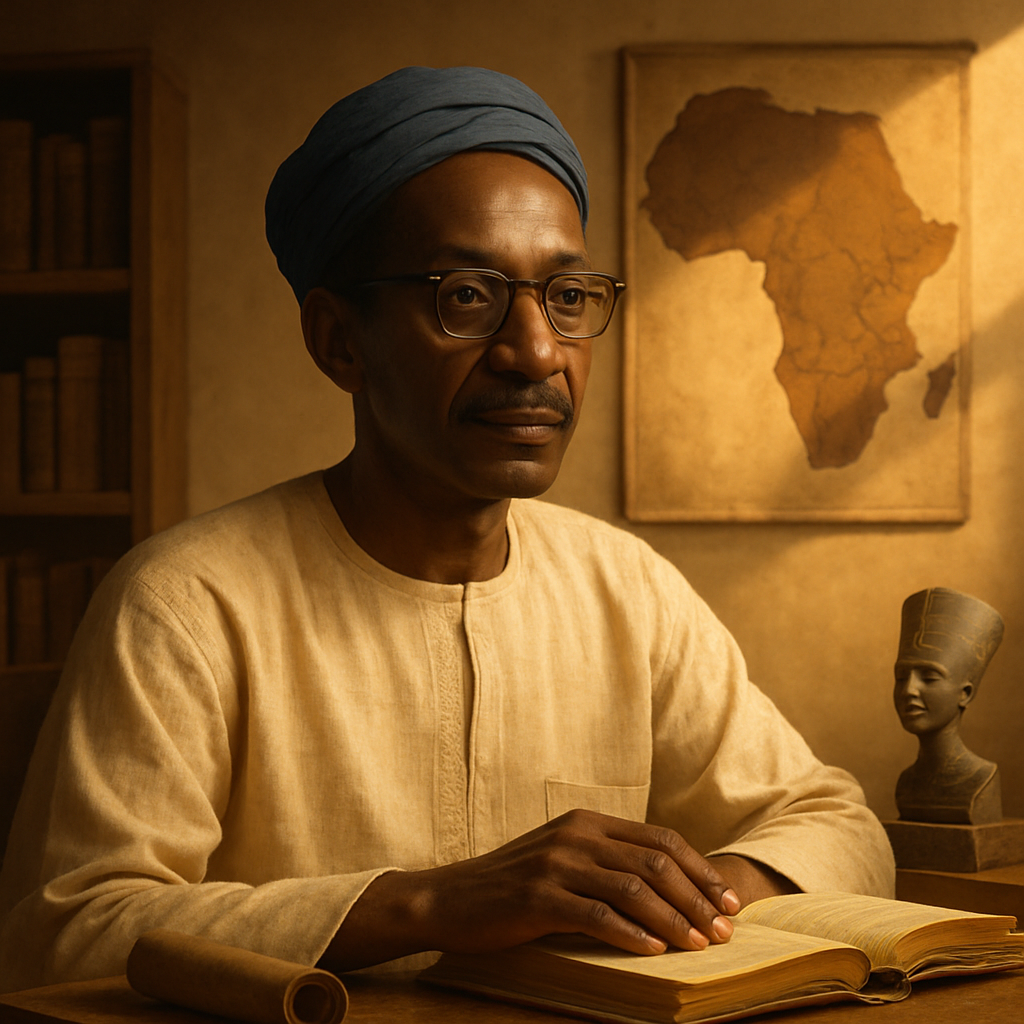
Cheikh Anta Diop
Challenged Eurocentric history by arguing for Africa as an active maker of civilization.
Life and thought
Investigates African history, Egypt, identity, civilization, language, and the politics of historical recovery.
Cheikh Anta Diop is presented in the Thought archive through historical thought, senegalese / pan-african, senegal, contemporary. The recorded life dates are 1923–1986. The profile connects this work to African Thought, History, Postcolonial Thought, Science.
The central questions gathered here concern African historiography, Egyptology, civilization, language, cultural memory. Together they show the recurring problems, methods, and distinctions that define this thinker’s contribution.
Cheikh Anta Diop developed within an intellectual conversation shaped by Pan-Africanism, Egyptology, African nationalism. These names provide context for the traditions and problems surrounding the work; they do not imply simple agreement.
The surviving reading path begins with The African Origin of Civilization, Civilization or Barbarism, Precolonial Black Africa. The recorded legacy extends toward Afrocentric scholarship, African historiography, decolonial history.
Five Defining Theories
The central ideas, methods, and arguments that give this thinker’s work its distinctive shape.
African historiography
A central idea in this thinker’s work, method, and intellectual legacy.
Egyptology
A central idea in this thinker’s work, method, and intellectual legacy.
civilization
A central idea in this thinker’s work, method, and intellectual legacy.
language
A central idea in this thinker’s work, method, and intellectual legacy.
cultural memory
A central idea in this thinker’s work, method, and intellectual legacy.
Life journey
A structured path through the verified context attached to this profile.
Context
1923–1986 · Senegal · Contemporary
Intellectual formation
The recorded influences include Pan-Africanism, Egyptology, African nationalism.
Defining ideas
The profile centres on African historiography, Egyptology, civilization, language, cultural memory.
The work
A reading path through The African Origin of Civilization, Civilization or Barbarism, Precolonial Black Africa.
Lasting influence
The recorded influence reaches Afrocentric scholarship, African historiography, decolonial history.
In time
Major Works
Texts through which the thinker’s ideas entered the wider intellectual record.
The African Origin of Civilization
This work matters because it carries a central part of the thinker’s method, argument, or intellectual legacy into a form readers can examine directly.
Civilization or Barbarism
This work matters because it carries a central part of the thinker’s method, argument, or intellectual legacy into a form readers can examine directly.
Precolonial Black Africa
This work matters because it carries a central part of the thinker’s method, argument, or intellectual legacy into a form readers can examine directly.
Influence network
Trace the intellectual lineage into and beyond this thinker.
Selected quotations
History must restore the consciousness of a people.
The security of a people depends on its historical consciousness.
Africa is not outside history.
Civilization is never the monopoly of one race.
Scientific truth must confront inherited prejudice.
Schools of thought
African Thought
Explore the thinkers and ideas connected to this tradition.
Explore school H8 thinkersHistory
Explore the thinkers and ideas connected to this tradition.
Explore school P22 thinkersPostcolonial Thought
Explore the thinkers and ideas connected to this tradition.
Explore school S60 thinkersScience
Explore the thinkers and ideas connected to this tradition.
Explore schoolConnected Thinkers

Rachel Carson
SharedScience · Contemporary
View thinker →
Niels Bohr
SharedScience · Contemporary
View thinker →
Werner Heisenberg
SharedScience · Contemporary
View thinker →
Erwin Schrödinger
SharedScience · Contemporary
View thinker →
Lewis Mumford
SharedHistory
View thinker →
Richard Feynman
SharedScience
View thinker →Featured Debates
See how Cheikh Anta Diop’s perspective changes when it meets another mind.



Should Historical Grievances Dictate Current International Relations?
The question of whether historical grievances should influence present-day international relations is a complex and contentious issue. In this Thought.global debate, Clara Zetkin, a prominent Marxist…
View Debate →

Preventing Unexamined Assumptions in Technological Advancement
The rapid pace of technological development poses risks if grounded in unexamined assumptions that contradict fundamental principles of human understanding. The central fault line is The…
View Debate →

The Consequences of Misunderstanding Natural Laws on Human Governance
The Consequences of Misunderstanding Natural Laws on Human Governance
View Debate →


The Fragility of Belonging: Deconstructing Community Norms in a Global Age
The Fragility of Belonging: Deconstructing Community Norms in a Global Age
View Debate →Continue the conversation with Cheikh Anta Diop.
Test an assumption, explore an idea, or bring this perspective into dialogue with a council of other thinkers.