
Alan Turing
Defined computation, advanced logic and codebreaking, and framed the modern question of machine intelligence.
Life and thought
Investigates computation, intelligence, logic, codebreaking, algorithms, and the boundaries of machine thought.
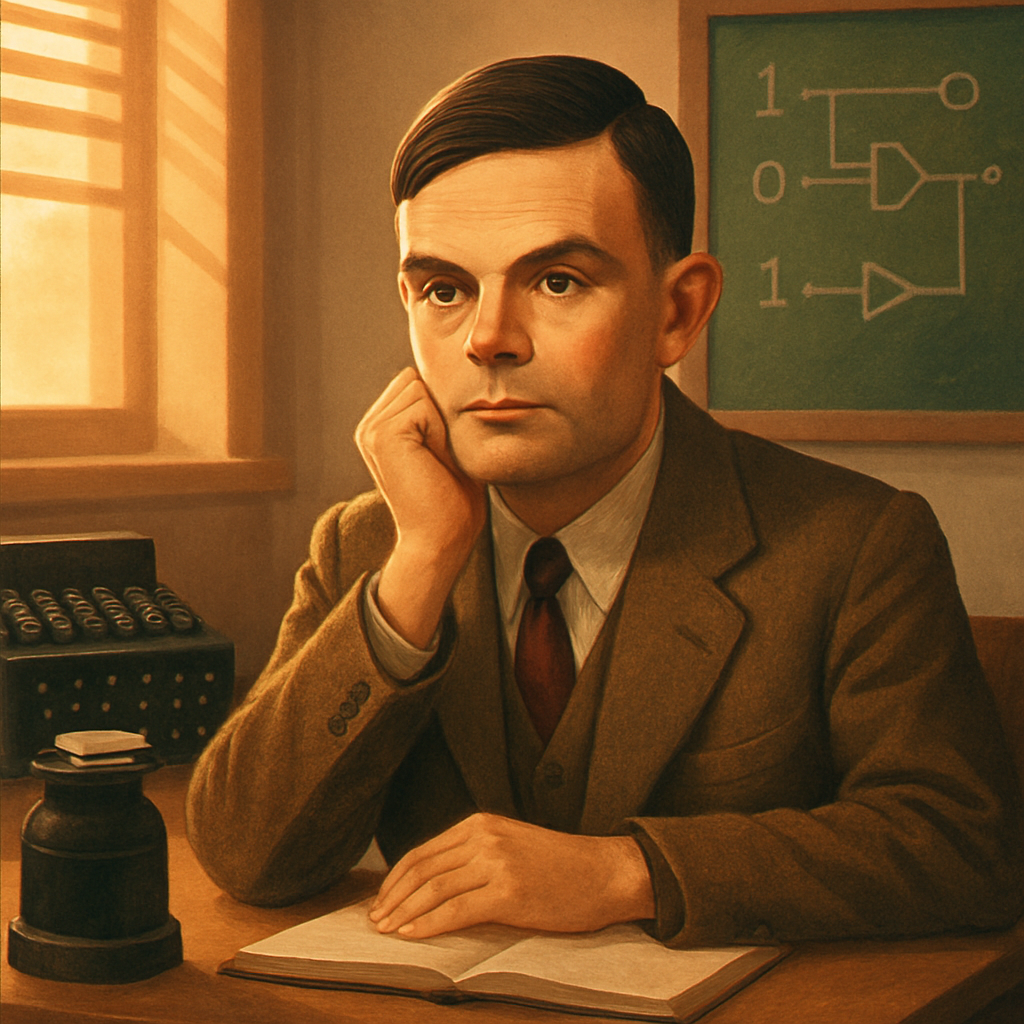
Alan Turing is presented in the Thought archive through mathematics, british, britain, modern. The recorded life dates are 1912–1954. The profile connects this work to Computing, Logic, Mathematics, Science.
The central questions gathered here concern Turing machine, computation, imitation game, algorithms, cryptanalysis. Together they show the recurring problems, methods, and distinctions that define this thinker’s contribution.
Alan Turing developed within an intellectual conversation shaped by Gödel, Hilbert, Church, mathematical logic. These names provide context for the traditions and problems surrounding the work; they do not imply simple agreement.
The surviving reading path begins with On Computable Numbers, Computing Machinery and Intelligence, Systems of Logic. The recorded legacy extends toward computer science, AI, cryptography, philosophy of mind.
Five Defining Theories
The central ideas, methods, and arguments that give this thinker’s work its distinctive shape.
Turing machine
A central idea in this thinker’s work, method, and intellectual legacy.
computation
A central idea in this thinker’s work, method, and intellectual legacy.
imitation game
A central idea in this thinker’s work, method, and intellectual legacy.
algorithms
A central idea in this thinker’s work, method, and intellectual legacy.
cryptanalysis
A central idea in this thinker’s work, method, and intellectual legacy.
Life journey
A structured path through the verified context attached to this profile.
Context
1912–1954 · Britain · Modern
Intellectual formation
The recorded influences include Gödel, Hilbert, Church, mathematical logic.
Defining ideas
The profile centres on Turing machine, computation, imitation game, algorithms, cryptanalysis.
The work
A reading path through On Computable Numbers, Computing Machinery and Intelligence, Systems of Logic.
Lasting influence
The recorded influence reaches computer science, AI, cryptography, philosophy of mind.
In time
Major Works
Texts through which the thinker’s ideas entered the wider intellectual record.
On Computable Numbers
This work matters because it carries a central part of the thinker’s method, argument, or intellectual legacy into a form readers can examine directly.
Read related Thought →Computing Machinery and Intelligence
This work matters because it carries a central part of the thinker’s method, argument, or intellectual legacy into a form readers can examine directly.
Read related Thought →Systems of Logic
This work matters because it carries a central part of the thinker’s method, argument, or intellectual legacy into a form readers can examine directly.
Read related Thought →Influence network
Trace the intellectual lineage into and beyond this thinker.
Selected quotations
We can only see a short distance ahead.
Sometimes it is the people no one imagines anything of who do things.
Machines take me by surprise with great frequency.
A computer would deserve to be called intelligent if it could deceive a human.
Mathematical reasoning may be regarded rather schematically.
Schools of thought
Computing
Explore the thinkers and ideas connected to this tradition.
Explore school L12 thinkersLogic
Explore the thinkers and ideas connected to this tradition.
Explore school M18 thinkersMathematics
Explore the thinkers and ideas connected to this tradition.
Explore school S15 thinkersScience
Explore the thinkers and ideas connected to this tradition.
Explore schoolConnected Thinkers
Ada Lovelace
SharedComputing · Mathematics · Science
View thinker →
Euclid
SharedLogic · Mathematics · Science
View thinker →
Kurt Gödel
SharedLogic · Mathematics · Modern
View thinker →
Hypatia
SharedMathematics · Science
View thinker →
Bertrand Russell
SharedLogic · Mathematics · British
View thinker →
Albert Einstein
SharedMathematics · Science · Modern
View thinker →Featured Debates
See how Alan Turing’s perspective changes when it meets another mind.


How Does the Digital Age Influence the Authenticity of Human Relationships?
In an era where digital communication is ubiquitous, the nature of human relationships has undergone significant transformation. This Thought.global debate explores how the digital age influences…
View Debate →

Can Artificial Intelligence Ever Truly Understand Human Emotions and Consciousness?
In this thought-provoking debate, we delve into one of the most intriguing questions of our era: Can artificial intelligence ever truly understand human emotions and consciousness?…
View Debate →
Is Technology Advancing Faster Than Our Ethical Ability to Manage It?
In an era marked by rapid technological advancements, questions arise about our ability to ethically manage these innovations. This debate brings together historical thinkers Blaise Pascal,…
View Debate →Continue the conversation with Alan Turing.
Test an assumption, explore an idea, or bring this perspective into dialogue with a council of other thinkers.