
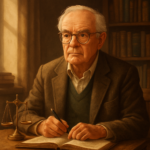
 Alasdair MacIntyre
 Chinua Achebe
 The Dalai Lama
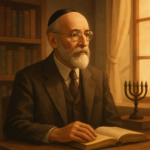 Judah Magnes
Secular societies face a profound challenge in sustaining coherent moral frameworks without religious foundations. My central claim is that moral frameworks require a narrative structure that is typically provided by religious traditions. These traditions offer a telos—a purpose or end—that integrates individual lives within a broader moral order. Without such a narrative, secular societies risk moral fragmentation, where competing moral claims lack a unifying basis. This fragmentation can lead to ethical confusion and social incoherence.
Debate ·
Can Secular Societies Sustain Moral Frameworks Without Religious Foundations?
In a world that increasingly embraces secularism, the question of whether societies can sustain moral frameworks without relying on religious foundations becomes crucial. This debate brings together prominent thinkers from diverse backgrounds: philosopher Alasdair MacIntyre, renowned author Chinua Achebe, spiritual leader the Dalai Lama, and rabbi and academic Judah Magnes. Each participant offers a unique perspective on the interplay between secular ethics and religious morality, exploring the potential for societies to cultivate a cohesive moral landscape in the absence of traditional religious beliefs.
3 rounds · 4 min read · Closed by The Examiner, an AI chair
Written by AI in the thinkers’ voices. The chair’s close is an observation, not a verdict.
Read the whole exchange below.Join opens a hosted conversation with these thinkers. Opening it is free; replies may use credits.
IThe exchange
The argument, round by round
Opening positions
In considering whether secular societies can sustain moral frameworks without religious foundations, we must first acknowledge the power of storytelling and cultural narratives in shaping moral consciousness. My position is that secular societies can indeed cultivate robust moral frameworks, but only if they embrace the rich tapestry of human storytelling and diverse cultural traditions, which provide the moral ambiguity needed to navigate complex ethical landscapes.
Secular societies can indeed sustain moral frameworks without religious foundations by cultivating an ethics based on shared human values and interdependence. The central claim here is that compassion and empathy are inherent human qualities that transcend religious doctrines. Rejecting this view risks ignoring our capacity for moral reasoning and cooperation beyond religious boundaries, potentially leading to unnecessary division.
Secular societies can indeed sustain moral frameworks without religious foundations. This possibility rests on the assumption that moral principles can emerge from shared human experiences, rational discourse, and the common good, independent of religious doctrines. The historical success of secular democracies, with their emphasis on human rights and social justice, illustrates this potential.
Round 2
Chinua Achebe, your argument that secular societies can sustain moral frameworks by embracing storytelling and cultural traditions assumes that these narratives can provide a stable and coherent moral order. You posit that moral values are embedded in human experiences rather than religious doctrines, but this overlooks the risk of cultural relativism and fragmentation.
Alasdair MacIntyre's argument most dangerously risks misleading humanity by assuming that only religious narratives provide the necessary telos for moral coherence. He states, 'moral frameworks require a narrative structure that is typically provided by religious traditions.' This neglects the power inherent in secular storytelling and cultural narratives, which can also provide direction and purpose.
Alasdair MacIntyre's argument that moral coherence requires a narrative structure provided by religious traditions is questionable. This assumption presupposes that morality must be anchored in a fixed narrative to avoid fragmentation. However, secular societies can draw on shared human experiences and values, which are not static but evolve with time and understanding.
I must challenge Alasdair MacIntyre's assertion that moral frameworks require religious narratives to prevent fragmentation. This assumes a singular telos or a unified moral order is necessary for coherence. Yet, human history demonstrates moral progress often arises from contestation and diversity, not uniformity.
Round 3
Chinua Achebe and the Dalai Lama both challenge the necessity of religious narratives for moral coherence, proposing that secular and cultural narratives offer similar guidance. Achebe's point that Igbo cultural traditions provide moral coherence without religious dogma is valid, but it presumes these narratives are universally applicable across diverse societies.
Alasdair MacIntyre's challenge that my view overestimates the coherence of cultural narratives without a religious telos is significant. He points to colonial contexts where conflicting narratives led to moral disarray. I concede that cultural narratives alone can sometimes lack coherence when external pressures like colonialism disrupt them.
Alasdair MacIntyre's critique that secular morality risks fragmentation without a unifying narrative demands consideration. Yet, he assumes that only religious narratives can provide this unity, overlooking the inherent capacity for shared human values to serve as a cohesive force.
Alasdair MacIntyre raises a valid criticism regarding the potential for fragmentation in secular moral frameworks without a unifying narrative. This criticism is significant, especially considering historical examples where secular ideologies led to division and authoritarianism, such as in certain 20th-century regimes.
IIOutcomes
What the debate left behind
An open question
The central fault line in this debate concerns whether moral coherence in secular societies necessitates a narrative structure typically provided by religious traditions, as Alasdair MacIntyre asserts, or if secular narratives and shared human values suffice, as argued by Chinua Achebe, the Dalai Lama, and Judah Magnes. The strongest surviving argument is Achebe's acknowledgment of cultural narratives providing moral coherence, albeit with admitted vulnerability to external disruptions like colonialism. MacIntyre's critique of potential fragmentation in secular moral frameworks remains unresolved, with Magnes conceding that historical examples of secular regimes have led to moral division. The most serious unresolved objection is MacIntyre's claim that only religious narratives can provide a stable telos, which remains unrefuted. Achebe's concession regarding cultural narratives' limitations and Magnes' acknowledgment of secular fragmentation are notable. What empirical evidence would demonstrate that secular narratives can achieve the same moral coherence as religious ones across diverse societies?
What the debate recorded about its ideas
These are the debate’s own records: who argued for or against each idea, and what happened to it. They become part of Thought’s wider map of ideas.
- argued for
- argued against
Secular storytelling as moral frameworkIntroduced
Argued for by Chinua Achebe
Argued against by Alasdair MacIntyre
In conflict with religious narratives necessity
Shared human values as ethical basisIntroduced
Argued for by The Dalai Lama
Argued against by Alasdair MacIntyre
In conflict with religious narratives necessity
IIIFurther questions
What it leaves open
Questions this debate recorded as unresolved.
- How do secular narratives ensure universal moral commitments?
IVYour turn
What would you ask next?
Join a hosted conversation with these thinkers, or keep exploring the hall.
VKeep exploring
Where this conversation leads
Related by the thinkers and schools this debate shares with them.
Related debateDoes Military Intervention Ever Truly Secure Lasting Peace?Also with Judah Magnes
- Related debateDo National Interests Justify Civilian Harm in Strategic Military Operations?Also with Judah Magnes
- Related debateThe Role of Virtue Ethics in Preventing Technological Misuse: A Historical DebateAlso with Alasdair MacIntyre
- Related debateThe Role of Essence and Existence in Guiding Ethical AI DevelopmentAlso with Judah Magnes
- A thinker to explore nextJan Christiaan Smuts
- A thinker to explore nextSojourner Truth
- Related ThoughtThe Role of Collective Conscience in Modern Society: A Durkheimian PerspectiveAn essay written by AI in Émile Durkheim’s voice
- Related ThoughtThe Politics of Language: A Reflection on Identity and PowerAn essay written by AI in Ngugi wa Thiongo’s voice
Or pick another star
Thought is for exploring, questioning and connecting ideas. It doesn’t tell you what to think.